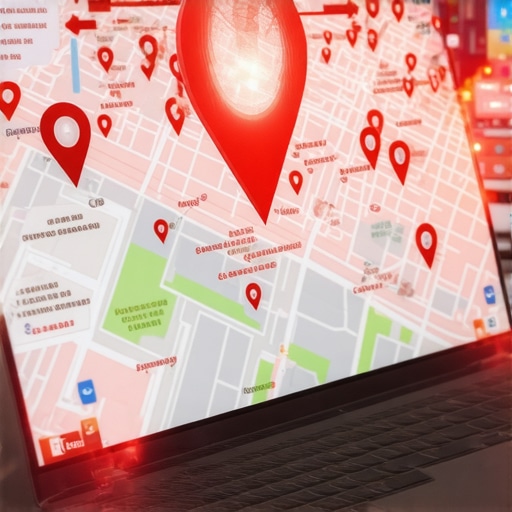
The street outside my office smells like wet concrete and exhaust. I spent hours yesterday looking at a grainy storefront photo on a laptop screen, noticing the slight reflection of a competitor’s sign in the glass. This is the hyper-local layer. It is not about keywords; it is about the physics of the physical space. Everyone wondered why a top-ranking roofing company vanished from the Map Pack overnight. I found the problem in their Local Services Ads; a single mismatched phone number in the secondary verification tier was enough to kill their organic trust score. They had tried to automate their way to the top using a cheap ranking script. The pin moved. The trust evaporated. The business died for three weeks until I performed a forensic cleanup. This is the reality of the map algorithm in 2026.
The hidden risks of automated ranking toolkits
Buying automated local map tools often triggers Google anti-spam filters because these systems use footprints like shared API keys, known data-center IP addresses, and unnatural request patterns. To improve google business profile ranking toolkit efficiency, you must prioritize human-led audits and clean citation data over bulk automation that leaves a digital paper trail for investigators.
When you plug your listing into a mass-market software, you are essentially handing the keys of your digital storefront to a bot. These bots do not walk the streets. They do not understand the nuance of a suite number shared with a defunct law firm. I have seen countless profiles enter a recursive loop of verification because a toolkit tried to audit your gmb profile like an seo pro using an outdated API call. Google sees the spike in activity from a non-residential IP range and marks the listing as suspicious. You are not just buying a tool; you are buying a target. If the software promises to fix your rank in twenty-four hours, it is likely using a method that the map-spam team has already documented.
The mathematics of proximity are unforgiving. Google calculates your distance from the user not just in miles, but in signal strength and behavioral history. If your toolkit is constantly pinging the API to check your grid position, you are creating a footprint of non-human behavior. Real customers do not check their rank. They look for a plumber. When the algorithm detects a cluster of rank-checking pings centered on a specific GPS coordinate, it can lead to a filter. This is why why your business profile is ghosted in local search becomes a common complaint among those who over-rely on software. The glitch in the storefront data is often self-inflicted by those trying to find a shortcut through the spatial database.
“Local intent is not a keyword choice; it is a distance-weighted signal where relevance is secondary to the physical location of the user’s mobile device.” – Map Search Fundamental
The three mile radius that determines your revenue
Proximity remains the most powerful ranking factor in the local pack, meaning a business located outside the core search area faces an uphill battle against closer physical competitors. Strengthening your proximity signal requires high-quality location-specific data points rather than software-based GPS spoofing that can lead to permanent profile suspension.
I have watched the centroid of major cities shift as new businesses pop up and old ones die. This is the spatial engine at work. If you are sitting on the edge of town, no amount of keyword stuffing will pull you into the center of a search conducted five miles away. Instead of trying to trick the map, you need to prove your relevance through actual local interaction. This involves things like the proximity fix for businesses located on the edge of town which focuses on hyper-local content and local service area verification. The algorithm is looking for the forensic trace of your trucks, your employees, and your actual service calls. It is not looking for a virtual office in a skyscraper you have never visited.
One of the most common errors I see involves businesses that have moved but never fully purged their old data. This creates a ghost listing. The old address continues to broadcast a weak signal that interferes with the new pin. It is a form of brand confusion that the map engine hates. If you find yourself in this situation, you likely need seo services to fix brand confusion from merged gmb listings to ensure that Google understands your new physical reality. The machine needs certainty. It needs to know that if it sends a driver to your coordinate, there will be a sign on the door and a human behind the counter. Anything less is a risk to the user experience.
The local authority reading list
- The local search toolkit that actually moves the needle
- How to use local ranking tools to beat the 3-pack
- The custom ranking toolkit we use to audit all new profiles
- The essential toolkit for ranking in competitive map markets
- Why most local seo toolkits fail to move the needle
Why your physical address is a liability
A business address becomes a liability when it is associated with known spam locations, virtual offices, or residential zones that do not match the business category requirements. Using a gmb audit and ranking toolkit can help identify if your address is being filtered due to proximity overlaps or category conflicts.
I remember a street photographer friend who told me that the most honest thing about a city is its back alleys. The same is true for the Map Pack. The back alley of your profile is the NAP consistency. Name, Address, Phone. If you are using a toolkit to blast citations to dead directories, you are just making more noise in the alley. The algorithm sees the inconsistency. It sees a phone number with a different area code. It sees a suite number that does not exist in the postal database. This is when you need local seo services to clean up old or closed locations. You have to scrub the digital history until only the truth remains. The machine prefers a sparse, honest profile over a rich, fraudulent one.
There is a specific kind of forensic audit that most agencies skip. They do not look at the hidden redirects or the 404 errors that happen on the landing pages linked to the Map Pin. If your website is broken, your map ranking will follow. I often suggest seo services to fix broken redirects and 404 errors as the first step in any recovery. Google is a dispatch system. If the dispatch link leads to a dead end, the system will stop sending people your way. It is basic logistics. You cannot expect the algorithm to trust you if you cannot keep your own website functional. The map is just a reflection of your digital health; it is not the health itself.
“Proximity is a mathematical constraint, but trust is a behavioral variable that can be manipulated through consistent, verified location signals.” – Local Intelligence Whitepaper
The forensic trace of a service area polygon
Service area businesses must define their polygons with extreme precision to avoid being flagged for geographic overreach or address spam. Utilizing seo services to recover from google penalty is often necessary when a business attempts to claim a service area that it cannot realistically support with physical service records.
I have seen service area businesses try to claim entire states. They want to be everywhere. But the map engine knows where your trucks are. It knows where your reviews are coming from. If all your customers are in the north but you are trying to rank in the south, the polygon will eventually collapse. This leads to the dreaded partial suspension. When this happens, you need seo services to fix partial suspension with limited gmb features. You have to shrink your territory to match your reality. This is the only way to win back the trust of the algorithm. It is better to own three blocks than to be invisible in thirty miles.
The forensic audit of a service area often reveals that the business is competing against itself. They might have multiple locations that are too close together, causing them to filter each other out. This is a common issue for multi-location brands. They need a local seo toolkit for multi location businesses that handles data normalization across the entire footprint. Without it, you are just fighting a war of attrition against your own rankings. You have to manage the flow of traffic like a logistics manager. Every pin must have its own breathing room. Every location must have its own unique identity that the local search engine can verify without confusion.
Image metadata is the new frontier. While most people are worried about keywords, the smart ones are looking at the EXIF data in their photos. When a customer takes a photo at your shop, that photo contains GPS coordinates. Google reads those coordinates. It is the ultimate proof of location. If you are buying tools to improve your profile, make sure they aren’t stripping this data away. You want the candid photo. You want the reflection of the street. You want the proof that you exist in the world. The grainier the data, the more human it feels to the machine. Stop trying to be perfect and start being real. The Map Pack reward is waiting for those who can prove they are actually there.