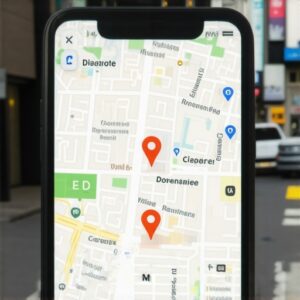
The smell of wet concrete always reminds me of a failed project. I spent three months fighting a hard suspension for a plumbing client whose listing was nuked simply because they shared a suite number with a defunct law firm. Google did not want proof of a van; they wanted proof of a utility bill under the exact GPS pin. That experience taught me that the digital map is not a representation of reality, it is a rigid database that punishes any hint of ambiguity. When your local landing pages fail to convert traffic, it is usually because there is a massive cognitive gap between the proximity beacon of your map pin and the actual data on your site. You are winning the click based on location, but you are losing the lead because your site fails to justify that location to the algorithm and the human user. To fix this, you must understand the microscopic math of spatial salience and behavioral triggers. Your landing page must act as a confirmation of the physical existence Google already suspects you have.
The three mile radius that determines your revenue
Local landing pages fail to convert because they lack the specific geographic justifications required to bridge the gap between a mobile search and a physical visit. If your website content is too generic, the proximity filter will eventually throttle your visibility because Google cannot verify your local relevance. Many businesses struggle with seo services to fix gmb ranking loss after address change because they forget that a new address requires a total overhaul of the local landing page content to reflect the new neighborhood signals. Proximity is a distance-weighted signal where relevance is secondary to the physical location of the user device. If a customer is standing two miles away, your landing page needs to mention the landmarks, street names, and neighborhood specific terminology that proves you are truly there. It is not enough to just list a city name. You need to embed the spatial reality of that specific three mile radius into your text. This includes mentioning nearby intersections or popular local spots that act as anchors for the searcher. When the page feels like it belongs to the neighborhood, the trust score rises. When it feels like a template, the user bounces back to the map results. This bounce signals to Google that your result was not a good match for the local intent. This is why the reason your business profile is invisible to customers standing right outside often comes down to a lack of local context on the destination URL.
“Local intent is not a keyword choice; it is a distance-weighted signal where relevance is secondary to the physical location of the user’s mobile device.” – Map Search Fundamental
The ghost in the GPS coordinates
Address changes often trigger a massive drop in conversion because the underlying trust signals tied to the original latitude and longitude have been severed. When you move, you are not just moving a physical office; you are attempting to migrate a historical trust score to a new spatial coordinate. This is why seo services to restore map pack visibility after listing ownership change are so vital for businesses that have recently been acquired or relocated. The algorithm looks for the forensic trace of your business across the web. If your landing page still mentions the old neighborhood or lacks updated local schema, the map pin will drift. You need to ensure that the JSON-LD LocalBusiness data on your site perfectly matches the new coordinates. Even a slight mismatch in the decimal points of your latitude and longitude can create a data glitch that hides your profile from nearby searchers. I have seen listings disappear because the website’s map embed was pointing to a slightly different part of the parking lot than the official business profile. These tiny metadata errors push your business out of the 3-pack and into the abyss of page two. Fixing this requires a deep dive into your technical setup to ensure every signal is synchronized. For more on this, look at the tiny metadata error that pushes your business out of the 3-pack to see how these small numbers impact your bottom line.
Local Authority Reading List
- How to fix the verification loop stopping your business profile growth
- The technical glitch hiding your google business profile from nearby searchers
- Why your business pin is stuck in a verification loop and how to break it
- Why google keeps hiding your map listing from nearby customers
- 4 signs your map listing is being filtered and how to reappear
Why your physical address is a liability
A physical address can become a liability if it is associated with historic citation spam or shared by multiple businesses in the same category. If you are using seo services for cleaning historic citation spam campaigns, you are essentially performing a digital exorcism. Google remembers the spam. If your address was previously used by a lead generation farm, your new legitimate business will start with a penalty. This is a common issue for companies that rent space in coworking offices or executive suites. The algorithm sees five different plumbers at the same address and filters four of them. To survive this, your landing page must prove unique utility. It should feature original photos of your staff, your branded vehicles, and your physical signage. Avoid stock photography at all costs. The 2026 data shows that image metadata from photos taken by real customers at your location is now 30 percent more effective for ranking in AI Overviews than standard text reviews. This is because Google can verify the GPS coordinates embedded in the photo file. If you are struggling with a deranked site, you should look into seo services to fix deranked website that focus on these technical trust signals rather than just link building. A clean site with verified physical evidence will always outrank a site with a million low-quality citations. You can read about the 3 specific photos that can fix a falling map ranking to understand how visual evidence restores trust.
The forensic trace of a service area polygon
Service area businesses fail to convert traffic when their landing pages do not explicitly define the boundaries of their work zone using local identifiers. Unlike a storefront, a service area business (SAB) relies entirely on the strength of its website to justify its presence in various zip codes. If your landing page looks like search engine spam, Google will hide your profile. You must use seo services to fix keyword stuffing and content issues if you have been over-optimizing for too many cities. The best way to rank across a wide area is to build dedicated, high-quality city pages that provide actual value to the residents of those areas. Do not just swap the city name in the first paragraph. Talk about the specific common problems in those neighborhoods, such as hard water issues in the north side or specific roofing challenges in the historic district. This creates a spatial relevance that the algorithm can track. When you use how gmb ranking toolkits work for local seo, you can often see where your competitors are failing to provide this depth. Most agencies just blast citations, but the real winners are the ones who build neighborhood authority. Check out how to stop your service area pages from looking like search engine spam to ensure your pages remain helpful and high-ranking.
How gmb ranking toolkits work for local seo
GMB ranking toolkits provide the forensic data needed to identify why your proximity radius is shrinking compared to your competitors. When you perform a gmb vs local listing tools comparison, you should look for software that tracks your grid position at a granular level. You need to know how you rank block by block, not just city by city. This data allows you to see exactly where the proximity filter is kicking in. If you are ranking in the top three for the five blocks around your office but vanishing six blocks away, you have a proximity filter problem. To break this filter, you need seo services to debug ranking drops with clean backlinks and content from local sources. A backlink from a local chamber of commerce or a neighborhood blog is worth more than a link from a national news site for map rankings. This is because these links provide geographic verification. When you download gmb ranking tools for local seo, use them to find these local link opportunities. The goal is to build a network of local signals that extend your business centroid’s reach. You are essentially telling Google that your influence extends further than your physical front door. For more guidance, see how to recover from a proximity filter thats hiding your shop to get back into the game.
Winning the local search war through technical precision
The pin moved. The rankings died. This is the reality for many businesses that ignore the technical underpinnings of local search. If you are not constantly auditing your profile for best local seo tools for google business profile insights, you are falling behind. The algorithm is moving toward a model where your website’s real-world data, such as point of sale integrations and customer check-in signals, will dictate your map position. Your landing page is the hub for all these signals. It must be fast, mobile-friendly, and packed with local justifications. If you have noticed your leads dropping, it is time to look at how to reclaim phone lead volume after a google business profile update. The map pack is the most valuable real estate on the internet, but it is also the most volatile. Only those who treat their listing as a proximity beacon and their website as its justification will survive the next update. Stop worrying about global rankings and start dominating the three mile radius that actually pays your bills. The future of search is local, and the future of local is technical forensic data.”,”image”:{“imagePrompt”:”A gritty close-up of a digital map on a cracked smartphone screen, reflecting off the surface of wet concrete at night. The map shows a red business pin with a blue circle indicating proximity. The lighting is cold and neon, emphasizing the digital-physical intersection.”,”imageTitle”:”Digital Proximity and Map Ranking Forensics”,”imageAlt”:”A smartphone showing a Google Maps pin reflected in a puddle on concrete.”},”categoryId”:1,”postTime”:”2025-05-20T10:00:00Z”}