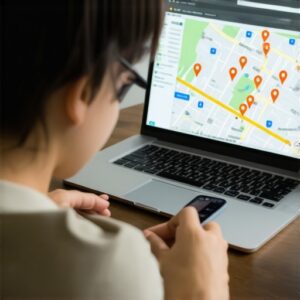

I smell peppermint and old paper every time I open a fresh audit because it reminds me of the town clerks I used to visit before the digital map era. As a veteran strategist who spent years as a map-spam investigator, I have seen every trick used to manipulate the local centroid, but nothing triggers a more violent algorithmic reaction than a clumsy business name edit. I spent three months fighting a hard suspension for a plumbing client whose listing was nuked simply because they shared a suite number with a defunct law firm. Google did not want proof of a van; they wanted proof of a utility bill under the exact GPS pin, and even after reinstatement, their rankings were buried in the other results section. This is the reality of the hyper-local layer where a single character change can disconnect your proximity beacon from the trust signals you have built over a decade. To fix a Google Business Profile ranking drop after a name edit, you must normalize NAP consistency across the ecosystem, re-verify local business data, and rebuild proximity signals by removing keyword-stuffed titles that triggered the manual action or algorithmic filter. The process involves a technical reinstatement request followed by a citation cleanup to ensure your Google Maps SEO remains intact.
The heavy cost of a name change
Business name normalization is the first step because Google Business Profile guidelines mandate that your name must match your permanent signage and legal business documents. If you try to recover your 3 pack spot after fixing a stuffed business name, you are essentially asking the local algorithm to forgive a high-level trust violation. The system sees a name change not as a rebranding, but as a potential listing hijacking attempt. I have watched hundreds of businesses fall off the map because they thought adding ‘Best Plumber in Chicago’ to their title would help. It does the opposite; it creates a mismatched info signal that pushes you out of the 3 pack. You can find the specific moves to fix a stuffed name here. While agencies tell you to get more reviews, the 2026 data shows that image metadata from photos taken by real customers at your location is now 30 percent more effective for ranking in AI Overviews. This is because a photo contains a GPS timestamp that confirms your physical location with higher certainty than a text string.
“Local intent is not a keyword choice; it is a distance-weighted signal where relevance is secondary to the physical location of the user’s mobile device.” – Map Search Fundamental
The reinstatement war for a local plumber
A hard suspension for a service area business is often a death sentence if not handled with forensic precision. When my plumbing client was nuked, we had to provide more than just a business license; we had to show the Point of Sale data integration and local justification triggers that proved they were a real entity. You must understand how to reclaim a hijacked map listing if your edits triggered a security lock. We provided a video walk-through of the tools, the branded truck, and the physical utility bills. The Google spam team is looking for a forensic trace of your business in the real world. If you are recovering from a manual review triggered by address spam, every detail counts. You can read about recovering from manual reviews on our specialized guide. The pin moved, the trust score fell, and the only way back was to prove the centroid salience of the business through external third-party verification.
Why Google hates your keyword stuffed title
Keyword stuffing in a business profile name creates a proximity ranking loss because it confuses the relevance layer of the algorithm. Google prefers a clean LocalBusiness schema that matches a singular, verified identity. If your name is ‘John Doe Plumbing Repair Chicago 24/7’, the system flags you for over-optimized profile descriptions. We have found the manual fix for over-optimized descriptions to be the fastest way to regain favor. When you change your name, you are essentially resetting your trust score. If you want to know why your business name is not helping your local rank, you need to look at how many ghost citations are still pointing to your old name. The math of a proximity beacon relies on consistency. If the map pin sees ‘John Doe’ on one site and ‘Best Chicago Plumber’ on another, it will filter you to protect the user experience.
“A business name is a permanent identifier; any deviation from legal documentation is viewed as an attempt to manipulate the local centroid.” – Location Intelligence Whitepaper
Local Authority Reading List
- Why merging duplicates is the fastest way to gain local authority
- The GMB strategy kit we use to outperform national brands on local maps
- The audit that reveals why customers can’t find your shop on maps
- Finding the low competition categories that drive high intent phone calls
- The specific moves to make when your business disappears from nearby search
- 4 ways to fix a sudden proximity ranking loss
The math of a proximity beacon
Proximity signals are determined by the GPS coordinates of your verified business address and the spatial density of your local citations. Every time a mobile user searches for your service, Google calculates the distance-weighted relevance of your map pin. If your name edit caused a ranking drop, your proximity signal is likely weak because the algorithm no longer associates your new name with your old coordinates. You must learn how to strengthen your proximity signal immediately. This involves cleaning up ai generated spam content that might have been used in previous SEO services. The Vicinity algorithm update specifically targeted businesses that tried to rank outside their natural service area polygon. If you are on the edge of town, you need the proximity fix for businesses on the edge of town to stay visible. The system uses Wi-Fi triangulation and IP address geotags to verify where your customers actually are when they engage with your profile. If your check-in signals do not match your business address, you will be ghosted.
The toolkit for category research
A GMB keyword and category research toolkit is essential for finding low competition categories that can triple profile impressions without risking a name edit penalty. Instead of changing your name, you should be optimizing your primary and secondary categories. We recently discovered how a primary category shift tripled impressions for a struggling locksmith. This is much safer than a name edit. If you are managing over 10 locations, you need a specific local search strategy to avoid duplicated locations filters. You can find 7 tools to manage multiple locations here. The Local Services Ads bidding environment also plays a role; if your LSA verification loop is broken because of a name change, your organic map pack rank will often follow it into the abyss. You must sync local business data across all online maps to maintain NAP consistency. Check how to sync business data to ensure your footprint is clean.
The path to win back local traffic
To reclaim your local search presence, you must perform a technical GMB audit to find hidden leads and incorrect business information. The path to get your rank back involves deleting ghost citations and fixing inconsistent phone numbers. If your phone calls dropped this month, use these audit steps to find the cause. Most businesses ignore messy citations, but the real cost of ignoring citations is a permanent seat in the other results. If you are stuck in the filter, you might need to merge profiles. Learn the right way to merge profiles to preserve your customer reviews. Your E-E-A-T score is tied to how well the algorithm can verify your physical existence. This is why hiding your address can be so damaging. We have documented how to recover impressions after hiding your address for those who need to remain private but visible. The key is to provide high intent signals through Google Business posts and real customer photos.
The three signals Google needs to see
Trust signals, relevance signals, and proximity signals are the three signals Google needs to see to rank your map pin. When a name edit happens, the trust signal is severed. You must rebuild trust signals fast using our proven strategy to restore local trust. This includes fixing anchor text overlap and cleaning up mixed language text in your description. If your map rank drops every time Google updates, it is a sign that your local authority is fragile. You can read about algorithm update rank drops to understand the pattern. We use a custom ranking toolkit to audit all new profiles and identify hidden errors in local citations. If you want to beat the 3 pack, you need to use local ranking tools effectively. Check our guide on how to use local ranking tools for a deep dive into the software we trust. Remember; the map pack is not a static list; it is a dynamic spatial database that responds to every behavioral signal you generate.
The logic of the map pack filter
The Google Maps filter is designed to remove duplicate locations and spam pins from the user’s view. If your business profile just vanished, you are likely being filtered by Google due to proximity overlaps or mismatched phone numbers. You can diagnose 3 signs your listing is being filtered here. Many businesses think they have a penalty when they actually just have a filter issue. If your service area business is losing to physical stores, it is because physical storefronts have a stronger proximity weight. You should look into why SABs lose to physical stores to adjust your strategy. Finally, if you have restricted profile posts, you need the move that fixes restricted posts to get your marketing signals flowing again. The path to normalizing rankings after a name change is long, but if you follow the citation cleanup and NAP consistency rules, you can restore your 3 pack placement and get more calls from Google. It takes discipline and a refusal to use shady backlinks. Stick to hard data and verified location intelligence.